If you've ever served on a church media team, you know the sound. The preacher is mid-flow, the congregation is paying rapt attention, and then it comes: "Media, give me that scripture!"
The first time, it’s a calm request.
Then, because the verse still isn't up, the second time is a little louder.
By the third time, you can notice the hint of annoyance in the preacher’s voice.
Suddenly every head in the auditorium turns to the back of the room, where one stressed volunteer is hammering a keyboard.
For Adeyemi Adesuyi, Media Director at a RCCG parish on Australia's Gold Coast, that sound was the soundtrack of every Sunday.
"When the minister says 'Give me that verse,' whoever is on projection has to type it and get it up there. And while you're still typing, you just hear 'Media!' twice. And everyone's attention is on you."
Today, that sound is gone. Here's how.
The setup: a tight ship on the Gold Coast
Adeyemi leads media and technical operations for a 160-seat parish in Queensland.
His team is ten active volunteers strong, with three trained specifically on projection. He runs it like a tight ship.
“Everyone knows what they’re responsible for.” He explains. “If you're going to project, you stick to projection. If you're on sound, you stick to sound. Videography, photography, post-production; everyone owns their lane."
Once the team arrives on Sunday, they put on the gadgets, run sound checks and set up for the day.
Mid-service, they coordinate on the floor over comms, and pack everything down at the end. It's a well-drilled operation.
But for all that discipline, one part of the service stubbornly refused to run smoothly: getting scripture on screen, fast.
The problem no presentation tool could fix
Before Pewbeam, the team ran ProPresenter, and later experimented with dedicated Bible-display tools.
None of it solved the core problem: the lag between a preacher saying a verse and that verse appearing on the screen.
But the cost went beyond awkward pauses. Volunteers were being affected too.
"A member actually left my department early last year," Adeyemi recalls. "During the sermon this person was always glued to the computer trying to pull up scripture, and so felt they were missing out on the service."
That's the hidden cost of the old workflow: the very people serving the congregation were the ones cut off from the worship they'd come for.
"This is magic!"
Adeyemi wasn't looking for a product the day he found Pewbeam.
He was just scrolling Twitter when a tweet from the founder, Dara caught his eye; something about building an AI-powered church presentation tool:
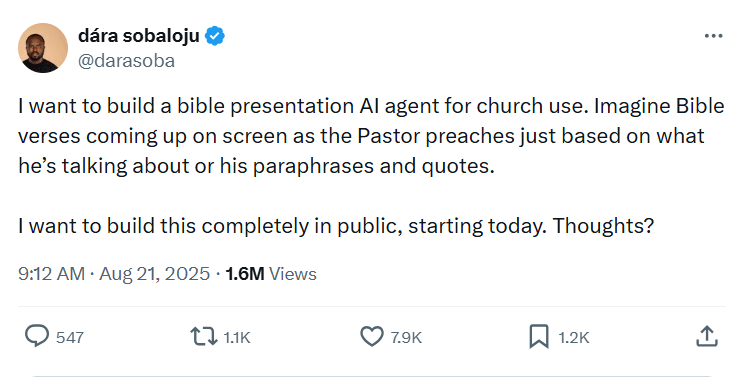
"Right there, I knew it. This is what I've been looking for. I exchanged a couple of DMs with Dara and told him, "I'm going to be the personal ambassador for your product in Australia." “
He followed along obsessively through every demo and update.
When Pewbeam finally launched, Adeyemi was one of the first people to download it.
He took it straight to his empty auditorium to test.
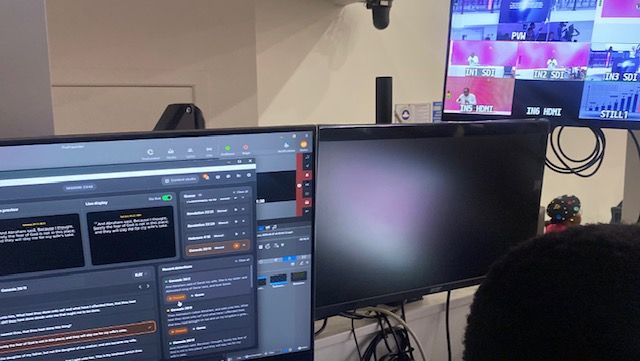
"I picked up the mic, started talking and on the screen the Bible verses were coming up on their own. I thought, ‘Oh my God, this is magic.’ "
He called the pastor in charge of his department and told him, “I’ve found what I’m looking for.”
Pewbeam put to the test
After purchasing a paid plan, the team's first live test wasn't even a regular Sunday, it was a special guest minister visiting from Nigeria.
This minister leaned heavily on storytelling, rarely calling out references.
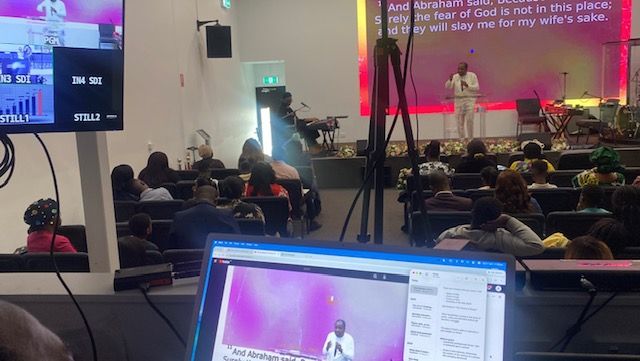
It didn't matter. "He'd be narrating a scenario, and the scripture would just appear on the stage screen. He kept saying, 'God bless whoever is behind that screen.' And you could tell that everyone knew that something had changed.”
After that service, a church member asked Adeyemi, “Have you heard about Pewbeam?”
He smiled and told him, “That’s exactly what we’re using.”
What actually changed
For Adeyemi, the best part of Pewbeam is more than the speed.
In his words, “It’s the fact that whoever is on the computer can actually be a part of the service. Sure, you still keep an eye on the system, but you’re more present than ever before. That's something that really gladdens my heart."
The congregation noticed too.
After one service, a member came up to him: "Who was the person on the PC today? They were really fast."
"I told him it's a new software. He said, 'You mean it's a software?' That got to me, because it meant the congregation noticed something had changed."
There's a deeper effect he didn't expect.
With verses reliably on screen, people now engaged with scripture more; jotting references down to study later, opening their Bibles to a story they'd never read.
"Maybe a young Christian has never heard the story of the Passover, and you just point them to where to read it. They write it down, they go home and open their Bible. You're helping them grow.
People think projection is just display, but our ministry is way more than that."
More than scripture on a screen
Another Pewbeam feature that Adeyemi fancies is the Content Studio. The team can now generate sermon notes, devotional, newsletters, and more… straight from the service.
"One of our youth pastors finished preaching, and before he even got home I sent him the sermon notes. He said, ‘Pewbeam did this?' I said yes."
For the volunteer who doesn’t get to focus on the message while serving, Adeyemi now just hands over the notes: read it when you get home. The social media lead gets a clean summary to drop into Canva to create designs.
"It's starting to feel like one solution that fits all."
What won him over
Adeyemi reserves some of his warmest words for the team behind it.
When his subscription license key didn't arrive immediately, he emailed, and got a near-instant response. When the transcription stopped working one Sunday, he flagged it and received an email confirming the fix.
"Your customer service is top-notch. We deal with a lot of organizations and you rarely get that. You guys are always available to solve people's problems, and that's a very, very big deal for me."
He's quick to be fair about the bumps, but he was impressed by the speed at which every issue was attended to. For Adeyemi, that responsiveness is part of the product.
Adeyemi’s message to those still doing it the old way
So what would he say to a media director who's hesitant to make the switch?
"I'd say: grow. One of the biggest problems in the body of Christ is adapting to new innovations. Let's get to a level where we are the ones championing innovation, instead of always waiting to inherit it from the world."
Then, more plainly: "You need to test this. You need to try it. It's worth it. I’m sure that once any leader tries it out, they’ll agree with me."
What's next?
Adeyemi is already watching for what's coming, especially lyrics support.
As he said, "You won't need to type your lyrics anymore? Do you know what that means?"
Until then, his verdict on life with Pewbeam is simple. Asked what a Sunday would look like if he had to go back, he laughed and refused to picture it.
"I don't even want to imagine it. We'd go back to the old way, and the congregation would notice immediately."
In RCCG Glory Tabernacle, no one shouts "Media!" anymore. And that, for a media team, might be the highest praise there is.
Ready to elevate your Sunday experience with Pewbeam? See what Pewbeam can do for your church.